
Where to watch the sunset in Mauritius
In Mauritius, you can only watch the sun set over the sea from the west coast and the northern tip. The best spot shifts with the seasons: in the southern summer the sun goes down towards the south-west, in winter towards the north-west. The time also varies by more than an hour, from about 5.40pm in late May and early June to nearly 6.55pm in January. Here are the best viewpoints, from Le Morne beach to Albion lighthouse, and sunset times month by month.
What time is sunset in Mauritius?
Mauritius has no daylight saving time and stays on GMT+4 all year. In Port Louis, the earliest sunset falls in late May and early June, around 5.37-5.40pm. The latest falls in January, around 6.55-6.57pm. Other towns on the island are within a minute or two.
Month by month (on the 15th, Port Louis, 2026): January 6.57pm, February 6.48pm, March 6.27pm, April 6pm, May 5.42pm, June 5.39pm, July 5.48pm, August 5.58pm, September 6.06pm, October 6.13pm, November 6.28pm, December 6.47pm. The light lasts about twenty minutes after sunset: civil twilight ends roughly 22 minutes later.
Le Morne and La Preneuse: the great classic
Le Morne beach, at the foot of the UNESCO-listed mountain, offers the island's most photographed mix of mountain and lagoon. Settle on the public beach on the north-west side.
From La Preneuse beach in Rivière Noire, the outline of Le Morne stands out in the distance: it is the photo spot for Le Morne glowing at sunset. The nearby Martello Tower can be visited beforehand (closed on Mondays).
Flic en Flac and Tamarin: a clear horizon
Flic en Flac beach faces west for several kilometres, so there is always room, and food trucks on the coast road sell rotis and gâteaux piments in the evening. The northern end is the quietest.
Tamarin Bay, more intimate, frames the sunset between its two headlands. Further north, Albion lighthouse stands on cliffs above the sea: the interior is closed to visitors, but the clifftop walk is worth it. The access road is narrow, so plan for driving back after dark.
The north: Mont Choisy, Pointe aux Canonniers and Bain Bœuf
The north-west coast faces west: Mont Choisy beach is known for its sunsets, as are the coves of Pointe aux Canonniers, reached by public paths between the hotels. Closer to Port Louis, Port Chambly makes a good stop for a sunset drink.
At the northern tip, Bain Bœuf and the Cap Malheureux area are at their best in the southern winter, when the sun sets in the north-west over the sea, with Coin de Mire offshore. For a photo of the red-roofed church itself, morning light is still best.
The south and the heights
On the southern coast road, Maconde viewpoint overlooks the sea between Baie du Cap and Le Morne. In the southern summer, when the sun sets in the south-west, it moves closer to the line of the coast.
To watch the sun go down over the capital, drive up to Fort Adelaide or climb Signal Mountain between 4pm and 6pm, when local runners are out. On the water, trips to Île aux Bénitiers from La Gaulette also look onto Le Morne, but most excursions return before sunset, so check timings with the operator.
And the east? Sunrise
The east coast faces the sunrise: Belle Mare is known for one of the finest on the island. The sun rises there around 5.20am in November-December and around 6.40am in June-July.
If you are staying in the east, the west coast is about an hour's drive away: leave at least 1h15 before sunset to have time to park.
Places in this guide

At the foot of Le Morne mountain, a lagoon in fifty shades of blue edged with immaculate sand and casuarinas. To the south, the 'One Eye' kitesurf spot ranks among the world's best.

A quiet Black River beach with one of the best views of Le Morne mountain, especially at sunset. Basalt-flecked sand, calm water and a peaceful residential feel.

The west coast's longest beach: 8 km of white sand lined with casuarinas along a reef-protected turquoise lagoon. Grand sunsets, easy snorkeling and a local weekend vibe.

The legendary bay where the Tamarin river meets the ocean, cradle of Mauritian surfing since the 70s. Volcanic-sand beach, beginner-friendly waves and a superb view of Rempart mountain.

A huge crescent of white sand running from Trou aux Biches to Pointe aux Canonniers, backed by a casuarina grove. Calm water and spectacular sunsets: an absolute northern classic.

A strip of white sand between Pereybère and Cap Malheureux, with an unbeatable view of Coin de Mire. Little known to tourists, its calm shallow lagoon is perfect with children.

A chic peninsula between Mont Choisy and Grand Baie, a former French battery with a few remaining cannons and an old lighthouse. Secret little coves and fine snorkeling spots.
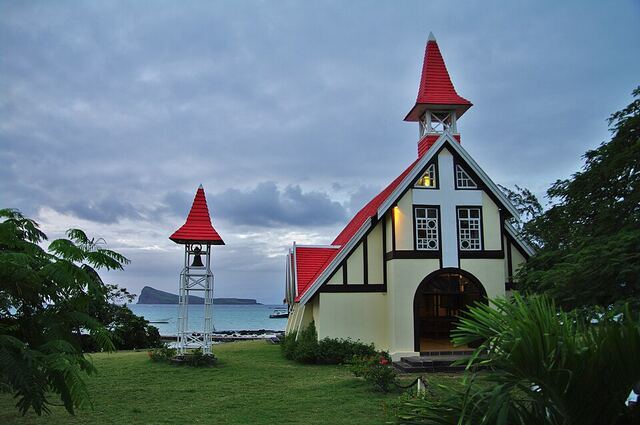
The famous red-roofed chapel facing the lagoon, with Coin de Mire as a backdrop: one of the most photographed views in Mauritius. The village marks the island's northernmost point.

One of only two working lighthouses in Mauritius (1910), standing on a wave-battered volcanic cliff. A wild, quiet site with superb west-coast views and theatrical sunsets.

A legendary hairpin bend cut into the basalt, where a small lookout overhangs waves crashing on the rocks. Splendid view over the bay and the coastal road below.
A small Mediterranean-style marina where the Terre Rouge river meets the sea, between Tombeau Bay and Arsenal. Colourful quays, moored boats and a handful of good restaurants (including Izumi, for sushi and teppanyaki) facing the sunset over the estuary.

A coconut islet about 2 km by 500 m in the lagoon, 500 m off La Gaulette. Photo stop (no landing) at Crystal Rock, a coral boulder rising from turquoise water, and snorkeling in a natural aquarium.

A black-basalt British fortress completed in 1840, perched on a hill above Port Louis. Climb up for the 360° view of the city, harbour, Champ de Mars and the Moka range.

Port Louis's urban hike: a broad track climbing to 323 m above the capital, ideal at sunset when the city and harbour light up.

A vast powdery white-sand beach running for kilometres along a crystal lagoon. The east coast's postcard, famed for its blazing sunrises.
Frequently asked questions
What time is sunset in Mauritius?
Between about 5.40pm and 6.57pm depending on the season. The earliest sunset is in late May and early June, the latest in January (Mauritius time, GMT+4, no daylight saving).
Where is the best sunset in Mauritius?
On the west coast: Le Morne beach, La Preneuse with the outline of Le Morne, Flic en Flac and Tamarin. In the north, Mont Choisy and Pointe aux Canonniers are the top spots.
Can you see the sunset over the sea from the east coast of Mauritius?
No, the east coast faces the sunrise. Belle Mare is one of the best sunrise spots on the island, but for sunset you need to head to the west coast or the north.
How long does twilight last in Mauritius?
About 20 to 25 minutes: in the tropics, night falls fast. Civil twilight ends roughly 22 minutes after sunset.
Does Mauritius change its clocks?
No, Mauritius stays on GMT+4 all year round. That is why the sun sets before 6pm in the southern winter.